
For a single shirt with photo-level detail, choose DTG. For 50 hoodies in three bold colors, choose screen printing. The line moves based on quantity and design complexity, and both Kornit and DuPont publish technical guidance confirming that pretreat and curing, not the printer type alone, decide how long either print survives the wash. This business uses both printing methods depending on the product, selecting the process based on the artwork rather than using a single method for all designs.
TL;DR:
- DTG is ideal for small runs with detailed, photo-realistic artwork, offering consistent per-shirt costs regardless of order size.
- Screen printing becomes more cost-effective than DTG starting from about 24 to 50 shirts, especially for designs with few colors and bold graphics.
- The durability of prints depends more on proper pretreating, curing, and ink quality than on the printing method itself.
- Certain fabrics, like technical polyester, favor screen printing due to DTG’s limitations with pretreat and ink adhesion.
- Hybrid workflows combining screen printing and DTG are common, allowing shops to optimize for design complexity, volume, and turnaround time.
Table of Contents
- Screen Print vs DTG: A Quick Side-By-Side Comparison
- What Is DTG Printing and How Does It Work?
- What Is Screen Printing and Why Does It Still Dominate Bulk Orders?
- How Do You Decide Between Screen Printing and DTG?
- How Much Does Screen Printing vs DTG Cost, and Where's the Break-Even?
- Which Printing Method Should You Actually Choose?
- How Do You Care for DTG and Screen-Printed Garments?
- How Disrespectfulapparel Chooses Printing Methods for Its Catalog
- Screen Printing and DTG Equipment: What's Changed
- What Ink and Color Options Work With Each Method?
- My Take: The Real Question Isn't Which Method Wins
- Order Custom Prints Without Guessing Which Method You Need
- Sources
- FAQ
Screen Print vs DTG: A Quick Side-By-Side Comparison
The fastest way to understand screen print vs digital printing is to look at what each one is actually built to do. DTG is a digital process, closer to running a shirt through an inkjet printer. Screen printing pushes ink through a stencil, one layer at a time. That structural difference drives almost everything else: cost, speed, and how many identical shirts you need before one method beats the other.
- Best for one to 24 pieces, complex art, photorealism: DTG wins because there's no setup cost tied to color count.
- Best for 24+ pieces of the same design, bold flat colors: screen printing wins because the setup cost gets divided across more shirts.
- Cost behavior: DTG pricing stays flat per shirt regardless of quantity; screen printing has a high first-unit cost that drops fast as volume climbs.
- Feel on the garment: DTG lays down a thinner, softer print when pretreat is applied correctly; screen printing (especially plastisol) can sit heavier and glossier on the surface.
- Fabric limits: DTG performs best on cotton and cotton-heavy blends; screen printing tolerates a wider range of fabrics and even tricky substrates like performance polyester.
- Sustainability: digital methods can reduce water and chemical use in certain industrial printing configurations, though the advantage depends heavily on machine setup and ink chemistry.
There's a middle ground worth knowing about: industrial-scale DTG platforms and hybrid digital-screen setups have narrowed the old gap in speed and durability, according to Kornit's own comparison. A shop running enterprise-grade DTG equipment can sometimes hit throughput that looks a lot more like screen printing than the desktop DTG machines most people picture.
What Is DTG Printing and How Does It Work?
DTG stands for direct-to-garment. Picture a large-format inkjet printer, except instead of paper, a shirt sits on the platen. The printer applies CMYK ink directly onto the fabric fibers, laying down a white underbase first when printing on dark garments so colors don't get swallowed by the fabric.
Before any ink touches the shirt, most cotton and cotton-blend garments need pretreat, a liquid solution sprayed on and heat pressed to prep the fibers for ink adhesion. DuPont's technical documentation on its Artistri pigment inks lays out specific pretreat formulations and curing parameters designed to maximize color vibrancy and washfastness. Skip or rush that step, and the print will crack or fade far sooner than it should.
Design files for DTG typically need to be high-resolution PNGs with transparent backgrounds, usually 300 DPI or higher, since the printer reproduces gradients, shadows, and fine detail the way a photo printer would. That's the format's biggest selling point: a portrait, a watercolor texture, a design with 40 subtle color shifts costs the same to print as a two-color logo.
The tradeoff is fabric compatibility. DTG performs best on 100% cotton or high-cotton blends because the ink needs natural fiber to bond with. Push it onto 100% polyester or heavily textured fabric, and results get inconsistent fast. Brother's curing guidance for its GTX platform stresses correct temperature and dwell time as the difference between a print that survives 50 washes and one that flakes after five.
What Is Screen Printing and Why Does It Still Dominate Bulk Orders?
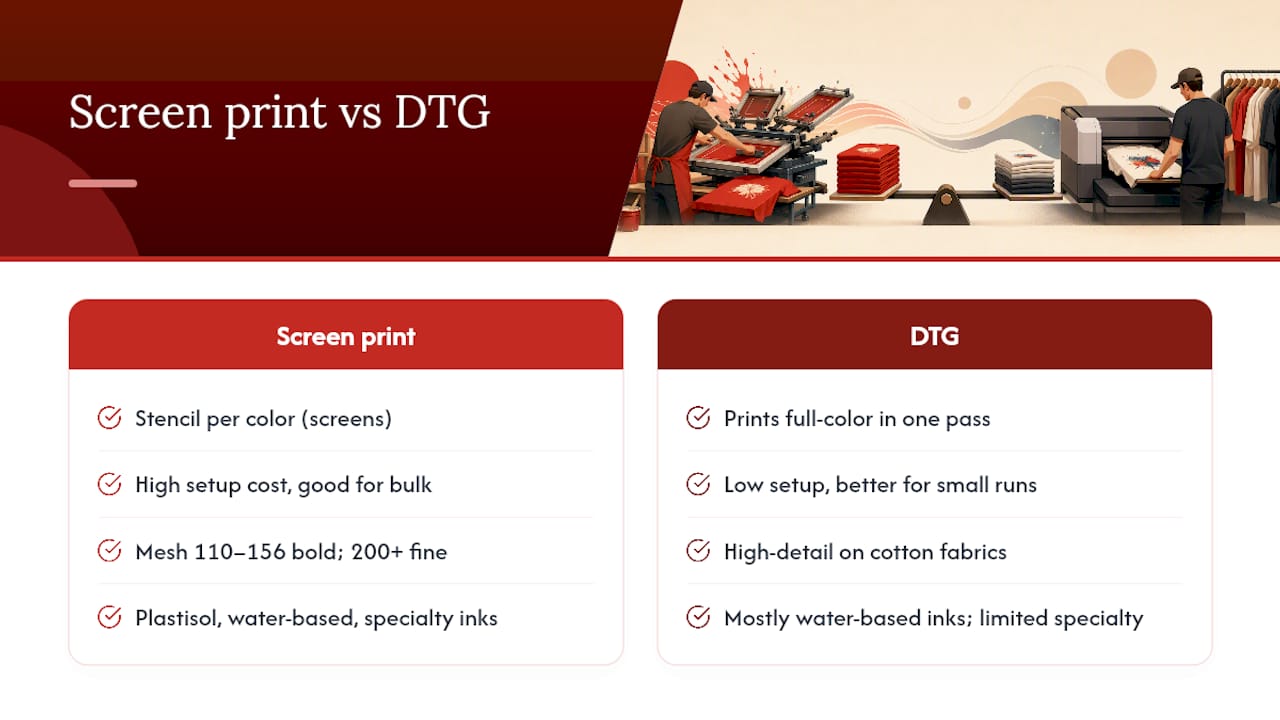
Screen printing starts with a stencil, called a screen, made from mesh stretched across a frame with a design burned into emulsion. Ink gets pushed through the open areas with a squeegee, one screen per color. A three-color design needs three screens, three passes, and precise registration to line every layer up.
That one-screen-per-color reality is the whole story behind screen printing's cost curve. Burning screens and setting up a press takes real time whether you're printing one shirt or 500, so the setup cost only makes sense once it gets spread across a decent quantity.
Mesh count, how tightly the fabric is woven into the screen, determines how much detail survives the process. Lower mesh counts (around 110 to 156) push more ink through and work well for bold, solid graphics. Higher mesh counts (200+) allow finer detail and smoother halftones, though they're slower to print and less forgiving of tiny registration errors.
Ink choice changes the outcome as much as the screens do. Plastisol ink sits on top of the fabric and cures into a slightly raised, opaque, durable layer. It's the industry default for a reason: it's forgiving, vivid, and holds up. Water-based ink soaks into the fibers instead, producing a softer hand feel that many people prefer for vintage-style prints, though it demands tighter process control. Specialty inks (metallics, glow-in-the-dark, puff, discharge) exist almost exclusively in the screen printing world because the technique lets shops layer and manipulate ink in ways DTG heads simply can't replicate.
For tough substrates like heavy canvas, technical fabrics, or anything outside the cotton-friendly zone DTG favors, screen printing usually remains the more dependable option.
How Do You Decide Between Screen Printing and DTG?
Every decision comes down to five factors: design complexity, quantity, fabric, budget, and turnaround. Weigh them in that order and the right method usually becomes obvious.
Design complexity splits cleanly. Photographic detail, gradients, and halftone shading favor DTG since the printer reproduces continuous tone the way a photo does. Bold, flat, one-to-three-color logos favor screen printing because plastisol ink lays down solid, punchy color that reads clean from a distance.
Durability doesn't have a single winner. Both methods produce long-lasting prints when the ink chemistry, pretreat, and curing process are handled correctly. A poorly cured DTG print will crack before a well-cured screen print does, and a poorly cured screen print will crack before a well-cured DTG print does. Process quality matters more than method.
A commonly cited industry rule of thumb puts the break-even point around 24 pieces, though Shopify's own analysis notes this shifts significantly based on the number of colors, print locations, and the specific shop's pricing structure.
Cost behavior follows two different curves entirely:
- DTG cost per unit stays roughly flat whether you order 1 shirt or 40, since there's no screen setup to amortize.
- Screen printing cost per unit starts high (covering screen burning and press setup) and drops sharply as quantity increases, especially past the 24 to 50 piece range.
- Adding print locations (front and back) roughly doubles setup work in screen printing but adds comparatively less to DTG, since there's no new screen to burn.
- Rush orders tend to hit screen printing harder, since burning screens and dialing in registration takes longer than sending a file to a DTG printer.
Turnaround generally favors DTG for small, urgent jobs. There's no screen-burning lead time, so a same-day order is realistic for many shops. Screen printing needs screen prep time upfront, but once screens exist, production runs faster per piece than DTG at high volume, since a press can slam out shirts far quicker than a printer can process individual files.
Fabric compatibility cuts the other direction. DTG needs cotton or high-cotton blends and a properly applied white underbase for dark garments. Screen printing handles a wider range of materials, including blends and technical fabrics that would frustrate a DTG pretreat process.
Sustainability is genuinely mixed. Some comparative environmental analysis suggests digital textile printing can use less water, chemical volume, and energy than certain rotary-screen configurations, but that advantage isn't universal. It depends on the specific equipment, the ink system, and the production scale involved. Made-to-order production, regardless of which printing method is used, cuts waste simply by avoiding unsold inventory sitting in a warehouse.
Plenty of shops run hybrid workflows: screen printing the main body design on a bulk hoodie run, then using DTG for personalized additions like a name or number on individual pieces. Neither method has to work alone.
How Much Does Screen Printing vs DTG Cost, and Where's the Break-Even?
Screen printing carries two cost layers: a setup fee (covering screen burning, roughly $20 to $50 per screen depending on the shop) and a per-unit print cost that drops as order size grows. Order 12 shirts and you're paying for four screens across only a dozen units, so per-shirt cost stays high. Order 200 and that same setup cost barely registers per piece.
DTG skips the screen fee entirely and charges close to the same rate per shirt no matter the order size, but throughput is the limiting factor. A DTG printer processes one garment at a time through pretreat, print, and cure, so very large orders take proportionally longer than a screen press running the same design over and over.
Here's how it typically plays out by order size:
- 1 shirt: DTG almost always wins. There's no setup fee to absorb, and one-off orders are exactly what the process was built for.
- 12 shirts: it depends on colors and complexity. A simple one-color logo might still favor screen printing; a full-color photo design favors DTG.
- 100 shirts: screen printing usually wins on cost per unit, especially for designs using two or three solid colors, unless the design has photographic detail that screen printing can't reproduce cleanly.
A handful of variables shift that math every time: the number of colors in the design, whether you're printing one location or several, the base cost of the garment itself, and whether you need a rush turnaround. Ask any printer for a quote at your specific quantity rather than assuming the 24-piece rule of thumb applies exactly to your order.
Which Printing Method Should You Actually Choose?
Match the method to your actual job, not to whichever process sounds more advanced. A few concrete scenarios:
- Independent artists selling one-off prints: go DTG. Low minimums and full-color capability matter more than per-unit cost when you're not ordering in bulk.
- Small brands launching a 50 to 100 piece drop with a two-color logo: go screen printing. The per-unit savings at that volume are hard to beat with DTG.
- Event organizers ordering 200+ identical shirts for a race or festival: go screen printing, and order early enough to account for screen setup time.
- Restocking a proven bestseller in the same design: screen printing again, since the screens may already exist from the last run and setup cost is already sunk.
- A design mixing a bulk screen-printed base with individual DTG customization (names, numbers) works well for team merch and personalized event apparel.
Before placing any order, ask your printer these nine questions: What file format and resolution do you need? Do you require pretreat testing on this exact fabric? What's your standard curing temperature and time? Can I see a physical proof before the full run? What's your minimum order quantity for screen printing? How do rush orders affect pricing and lead time? What garment blends work with your DTG setup? How many wash cycles do your prints typically survive? What happens if colors don't match my proof?
Pro Tip: Send your file as a layered PNG or vector file with exact color values (Pantone or CMYK) noted, and ask for a physical proof before committing to a full run. Screen color rarely matches what you see on a monitor.
How Do You Care for DTG and Screen-Printed Garments?
Wash inside out in cold water, skip the dryer's high heat setting, and avoid fabric softener, which breaks down ink adhesion over time on both print types. Brother's curing tutorials for GTX printers stress that under-curing is the most common cause of DTG prints cracking early, since ink that hasn't fully cured never bonds properly with the fibers.
Ask your printer how they cure prints, not just what ink they use. A shop running the correct dwell time and temperature on a properly pretreated garment can produce a DTG print that easily survives 50+ wash cycles. A rushed job with inconsistent curing might crack in under ten. The same logic applies to screen printing: plastisol that's under-cured stays tacky and peels early, no matter how good the artwork looked coming off the press.
How Disrespectfulapparel Chooses Printing Methods for Its Catalog
The company utilizes a made-to-order production model, meaning items are produced only after an order is placed, which helps reduce overstock waste. This approach influences the choice of printing method for each product.
Detailed, illustration-heavy tee graphics—the kind with shading, texture, and fine linework—lean toward DTG, since the process reproduces that level of detail without demanding a giant order to justify screen setup. Large, bold back-print designs on hoodies with heavy ink coverage and solid color blocks are a more natural fit for screen printing's opacity and durability on big-format prints.
The brand emphasizes original artwork for its tattoo, biker, and dark-humor themed apparel to maintain an authentic, handmade feel rather than using clip-art or stock graphics. Standard U.S. shipping is offered across the product catalog.
Screen Printing and DTG Equipment: What's Changed
Industrial DTG platforms have closed a lot of the gap that used to separate DTG from screen printing on speed and durability. Where early desktop DTG printers struggled with throughput and inconsistent curing, current commercial-grade systems process garments faster and apply pretreat with far more precision, which directly improves washfastness.
Hybrid digital-screen setups are also becoming more common in production shops. A shop might screen print a bulk base design, then run DTG passes for smaller customized elements, combining the cost efficiency of screens with the flexibility of digital printing on the same garment.
Pretreat application itself has gotten more automated. Early DTG shops sprayed pretreat by hand, leading to inconsistent coverage and patchy washfastness. Automated pretreat machines now apply a more even layer, which manufacturer documentation from both DuPont and Brother identifies as one of the biggest levers for improving print longevity.
None of this erases the fundamental math, though. Screen printing still wins on raw per-unit cost at high volume, and DTG still wins on flexibility for small runs and complex art. Equipment upgrades have shifted the margins at the edges, not rewritten the core rule.
What Ink and Color Options Work With Each Method?
DTG printers typically run CMYK ink plus a white underbase, which lets them reproduce nearly unlimited color combinations and gradients in a single pass, since the printer mixes color digitally the way a desktop printer does. There's no practical limit on how many colors a DTG design can use, which is exactly why it handles photorealistic art so well.
Screen printing works in discrete ink layers, one screen per color, which caps most jobs at a handful of colors before cost and registration complexity make it impractical. Plastisol remains the standard because of its durability and vivid opacity. Water-based ink gives a softer hand feel and works well for a vintage, worn-in look. Specialty options, metallic, glow-in-the-dark, puff, and discharge ink, exist almost entirely in the screen printing world, since they rely on physical ink deposits that a digital printhead can't replicate.
Neither ink system is objectively better. Plastisol holds color and opacity longer on bold graphics; DTG's digital color range wins when a design needs shading, blending, or photographic tone that no plastisol formula can reproduce cleanly.
My Take: The Real Question Isn't Which Method Wins
Most articles frame screen print vs DTG as a battle with a permanent winner. It isn't. The better question is whether your printer actually controls their process, since pretreat and curing quality swing outcomes more than the method itself.
If you're ordering one shirt with detailed art, ask for DTG. If you're ordering 100 shirts in two colors, ask for screen printing. Either way, ask to see a proof and ask how they cure it. That single question filters out more bad printers than any spec sheet ever will.
— nicholas
Order Custom Prints Without Guessing Which Method You Need
This apparel provider differentiates itself by matching the printing process to each design's needs, such as DTG for detailed illustrations or screen printing for bold hoodie prints, and producing items only upon order.
That made-to-order model means you're not choosing between quality and waste. Original art, no clip-art shortcuts, and free standard U.S. shipping come standard whether you're eyeing a graphic tee or a flat-bill hat. Browse the T-Shirts collection for detailed, DTG-friendly graphics, check Hoodies for bold back-print designs, or grab the Stay Rad Skull Girl T-Shirt if you already know what you want on your back. Pick a design, place the order, and let the production process match the method to the art.
Sources
- DTG vs. Screen Printing: Factors to Consider for Your Brand (2025) - Shopify
- DTG Printing vs Screen Printing | Kornit Digital
- DuPont Artistri DTG pigment inks and pretreat guidance (PDF)
- Curing the GTX Ink and Pretreat (Brother)
FAQ
What Lasts Longer, Screen Printing or DTG?
Neither method wins automatically. Durability comes down to ink chemistry, pretreat quality, and correct curing rather than which printer is used, and both methods can last through dozens of washes when the shop handles the process correctly.
What Are the Disadvantages of DTG Printing?
DTG works best on cotton and cotton-heavy blends, struggles with tricky substrates like technical polyester, and its per-unit cost doesn't drop with volume the way screen printing's does. It also depends heavily on correct pretreat and curing, since skipping or rushing that step is the most common cause of premature cracking.
How Do You Tell DTG From Screen Printing on a Shirt?
DTG prints usually feel soft and sit almost flush with the fabric since the ink absorbs into the fibers. Screen-printed designs, especially with plastisol ink, often feel slightly raised and glossier, with more visible opacity on dark garments.
Is DTG or Screen Printing More Expensive?
It depends entirely on order size. DTG costs roughly the same per shirt no matter the quantity, while screen printing carries a higher upfront setup cost that drops sharply per unit as order size grows. Shopify's cost breakdown notes there's no single break-even number since color count, print locations, and provider pricing all shift where that line falls.
Does Disrespectfulapparel Use DTG or Screen Printing?
Disrespectfulapparel matches the printing method to the design, using DTG for detailed graphic tees and screen printing for bold back-print hoodie designs. Every piece is made-to-order with original art and current pricing listed directly on each product page.